Jinita Lourembam
Research Scholar, Animal Physiology Laboratory,
Department of Zoology, Manipur University, Canchipur-795003.
jinitalourembam@gmail.com
Edible freshwater snails belong to class Gastropoda of phylum Mollusca. Freshwater snails are widely distributed in rivers, ponds, lakes, fish farms, reservoir banks, and paddy fields. Apart from regularly consuming meat, snail meat is also one of the non-typical sources of meat protein in India. It has been reported that 29 tribal groups in India consumed snails, generally in the states of Bihar, Jharkhand, Maharashtra, West Bengal, and the entire northeastern regions.
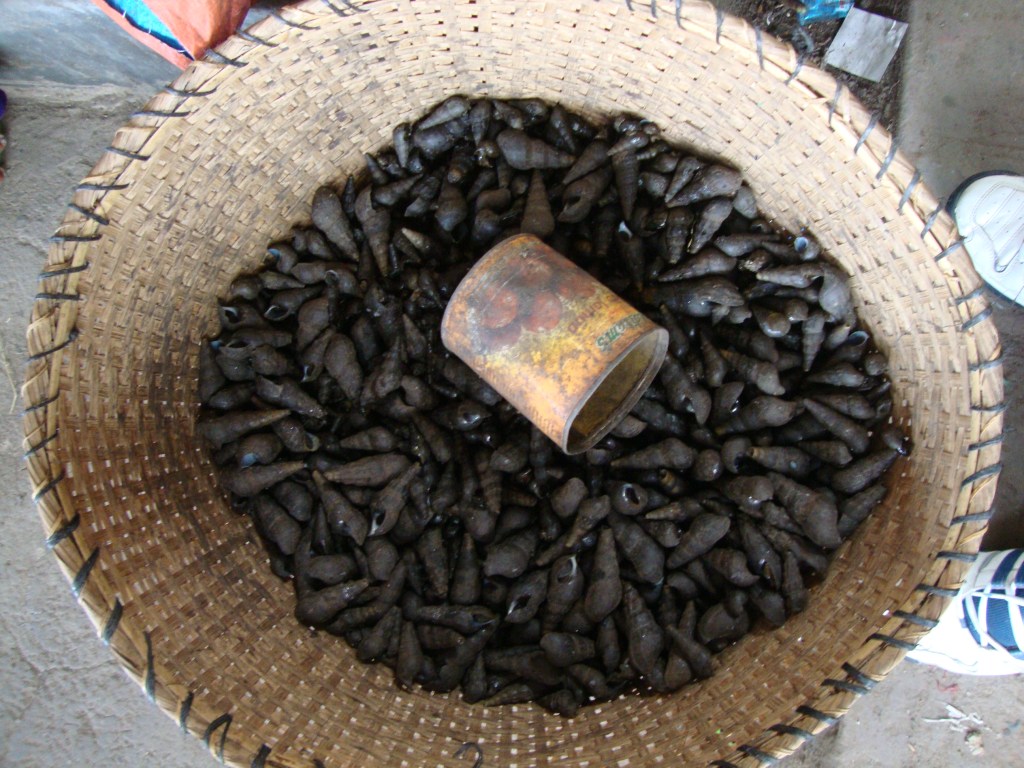
Snails are considered delicacies, are neutral to taste, have a firm texture and are slightly chewy. Snail meat across the globe is famous for its culinary delicacy, excellent flavour, nutritional value and therapeutic properties. They also possess various medicinal potentials against a broad spectrum of human ailments, including anti-inflammatory, antimicrobial, anti-osteoporotic, anti-cancer, anti-hypertensive, anti-diabetic, and antioxidant properties. In Manipur, snails, locally known as “Tharoi”, are consumed as an authentic cuisine since time immemorial and are also used as ethnic medicine. “Tharoi thongba” is a popular traditional food of the ethnic people in Manipur for its unique umami taste, aroma, and flavour. Freshwater snails are in great demand, as they are readily available for collection and also have economic importance to the ethnic community and local farmers who sell them in the local market. In Manipur, freshwater snails are available at Khwairamband Market, Waithou Market, Senapati Ima Market, Moirang Market, Ukhrul Market and other local markets such as Mayang Imphal Market, Nambol Market, Pukhao Naharup Market, Wangjing Market, Sangakpam Market, Keishamthong Market, Singjamei Market, Chingmeirong Market, Khurai Lamlong Market, Khurkhul Imoinu Market, etc. The most popularly consumed freshwater snails in Manipur and the northeastern states of India are Filopaludina bengalensis (locally, Tharoi Ninggabi), Cipangopaludina lecythis (locally, Labuk Tharoi), Brotia costula (locally, lai Tharoi), and Paludomus pustulosa (locally, Nung Tharoi).
Traditional knowledge related to snails:
In Manipur, traditional knowledge associated with freshwater snails is that Brotia costula, locally known as “Lai Tharoi”, is used in the preparation of the local dish “Tharoi thongba” and is consumed in the dinner preceding the first day of the Meitei New Year, locally called “Cheiraoba”, on a folk belief of the Meitei community so as to have good health, provide nutritional supplements & boost immunity by purifying blood. Tribal communities in Manipur believe eating snails enhances or helps maintain good eyesight and normal functioning of the kidneys. Filopaludina bengalensis, locally known as “Tharoi Ninggabi”, is used in the treatment of smallpox by consuming a few drops of extract from the apex/tip of the snail and also by adding the extract to water for bathing, with a belief that it promotes wound healing.
Culinary traditions of freshwater snails in Manipur:
For the preparation of snail culinary in Manipur, a proper traditional method which is handed down from one generation to the next is followed. This systematic preparation method can be briefly described as – snails are washed several times until the water becomes clear, followed by cutting off the tip/apex of the snail, and then they were soaked in water with salt overnight before cooking. This helps in removing the unwanted substances (mud, parasites, debris, young snails) from the snails. In the next morning, it is again soaked in rice water for 1 hr before cooking and washed 5-8 times. The major tribes, i.e., the Meitei and Naga tribes, inhabiting Manipur consume snails in different forms. Although there are various forms of cooking snails, the main procedure is almost the same with a variation in the accompanying ingredients. Some of the different snail culinary dishes popularly consumed in Manipur include snails with loklei (traditional Tharoi thongba), snails with pumpkin (Tharoi-Mairen Thongba), snails with pork (Tharoi-Oaksha Thongba), snails with fermented bamboo shoots (Tharoi-Soibum Thongba), snail fritters (Tharoi Bora), steamed and baked snails (Tharoi Paknam) and snail stir fry (Tharoi alu Kanghou). Overall, this snail dish of Manipur is still attached to its roots and is very authentic, and the flavours are unique with different herbs, seasonal vegetables and local spices, which is healthy and nutritious.
Freshwater snails and their nutritional values:
A recent study on the evaluation of element content in Filopaludina bengalensis, Cipangopaludina lecythis, Brotia costula, and Paludomus pustulosa provides a good source of essential major elements such as potassium, calcium, phosphorus, and magnesium and essential trace elements such as zinc, copper, selenium, and chromium, which are essential for various biochemical and physiological processes in the human body. Also, there is no detection of Cd, As, and Pb, which indicates that they are safe for consumption. The concentration of the major and trace elements in the four snails can be summarised in descending order as Mg > K > P > Mn > Ca > Zn > Cu > Cr > Se. Different freshwater snails are reported for their high content of macro- and microelements, including trace elements essential for human health. Studies reported the high and notable concentrations of essential major (Ca, P, Mg, K, Na, Cl) and trace elements (Fe, Cu, Zn, Mn, Cr, I, Se) in freshwater snails such as Bellamya bengalensis, B. costula, Bellamya dissimilis, Pila globosa and Pomacea canaliculata. These snails are enriched with good fats such as MUFAs (mono unsaturated fatty acids) and PUFAs (Poly Unsaturated Fatty Acids) that improve HDL (high-density lipoprotein) and maintain normal blood cholesterol levels, which is vital for human health. Freshwater snail meat also provides abundant concentrations of essential amino acids, where lysine, leucine and threonine occur as the highest essential amino acids.
Freshwater snails and their therapeutic values:
Snails provide a wide range of bioactive compounds, and snail extracts are a good source of various peptides possessing therapeutic potential.Different studies had investigated the therapeutic values of various freshwater snails and revealed that Pila globosa extract exhibited antibiotic and antifungal activity; protein hydrolysates extracted from Paludomas conica showed antioxidant activity and ameliorated diabetes-related complications, thus showing anti-diabetic potentials. A peptide obtained from Bellamya bengalensis showed antihypertensive potential by showing the best ACE-inhibitory activity. A bioactive compound, stigmasta-4,22-dien-3-beta-ol in Pila globosa, was also reported for its anti-osteoporotic potentials and treatment of other bone-related diseases. Findings also reported that the lipid extract from Bellamya bengalensis has anti-inflammatory potential. Further, the apple snail extract was also found to have good anti-inflammatory effects as it lowers the concentration of pro-inflammatory cytokines, TNF-α pro-inflammatory cytokines, and increases IL-10 (anti-inflammatory cytokines), which can be a good candidate as anti-inflammatory agents in the treatment of various human ailments.
Conclusion:
Overall, several studies on different freshwater snail species consumed across the world and including Manipur confirm that snail meat can be a healthful diet with good nutritional and therapeutic values. The occurrence of several bioactive compounds can be used to develop new formulations of drugs with fewer or no side effects to humans and can be purified and explored for pharmaceutical and food industry applications. Moreover, it is also necessary to promote and conserve the traditional cooking methods of freshwater snails, as it provides a healthy, rich and unique flavour with natural ingredients with no processed ingredients. Snail farming can also be promoted as a source of livelihood to the local people and could also overcome the food insecurity issues.
